| |
The Boston Foundation for Sight
Background
Perry Rosenthal, M.D., founder of the Contact Lens Service at the Massachusetts
Eye and Ear Infirmary and assistant clinical professor of ophthalmology,
Harvard Medical School, has developed a unique vision-restoring lens known
as the Boston Scleral Lens. Nineteen years in development, it is the product
of advanced polymer chemistry, a powerful computer-driven design program
and state-of-the-art precision machining technology. This prosthetic device
was approved by the FDA in 1994 and has restored vision in more than 600
patients, most of whom had exhausted all other treatment options. Dr.
Rosenthal created the 501 (c)(3) nonprofit Boston Foundation for Sight
to provide this technology to all who it can benefit. No one is turned
away because of their ability to pay. Supported by Bausch & Lomb since
its inception and by a $240,000 grant by Johnson & Johnson to train
doctors in the special custom-fitting process, the Foundation’s
mission is to establish a network of affiliated clinics in academic eye
care centers in the U.S. and abroad
Why is the Boston Scleral Lens Unique?

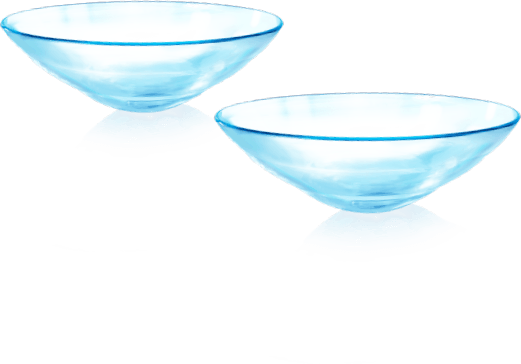
The quarter-size highly oxygen-porous Boston Scleral Lens Prosthetic
Device is designed to rest on the tough relatively insensitive white tissue
of the eye called the sclera. The key to its effectiveness is the artificial
tear-filled reservoir that it maintains over the diseased cornea, the
principal focusing lens of the eye and the most sensitive tissue of the
human body. By functioning as a soothing and healing liquid eye bandage,
this device relieves the pain and light sensitivity of severe dry eyes
and chronic corneal inflammation while nurturing the healing of erosions
and ulcers even in eyes that have failed to respond to all other available
treatments. It is no wonder that our patients call it their “Miracle
Lens”.
The first generation of Boston Scleral Lens were very large to take advantage
of the unevenness of the sclera in the deep recesses under the lids. This
allowed tears to seep under the edge of the lens to prevent the lenses
from becoming suctioned to the eye. However, the unpredictability of this
design and the difficulty of inserting these huge lenses led Dr. Rosenthal
and his team to develop a new generation of smaller Boston Scleral Lenses
in the fall of 2003. Utilizing patented technology and powerful design
software developed by the Boston Foundation for Sight, the new design
incorporates precision-machined trenches in the lens to channel tears
into the fluid reservoir of the lens while preventing the aspiration of
damaging air bubbles. The Foundation’s success rate today exceeds
90%--a remarkable achievement considering that our patients suffer from
some of the most devastating of blinding eye diseases.
The Foundation’s onsite laboratory enables us to custom design
each lens on a computer, transmit the data to our state-of-the-art precision
computerized lathe and have the lens in hand within 60 minutes rather
than the two days that would be required if they were made in a commercial
laboratory. Since the process of customizing the design of each lens to
the shape of each eye requires us to fabricate an average of three to
five devices for each eye (it is not unusual to require 12 or more) having
our clinical and manufacturing facilities under one roof enables us to
achieve an unparalleled rate of success in the most challenging eyes.
The imminent delivery of a $400,000 state-of-the-art lathe/milling machine
designed and programmed to meet our special requirements will enable us
to extend its unique therapeutic and vision-enhancing potential to more
people than ever before.
Because we refuse to compromise our efforts to achieve the best possible
outcome, the custom fitting process is skill intensive, time consuming
and costly. As a 501(c)(3) nonprofit institution, a substantial part of
the treatment costs are subsidized by our generous benefactors whose support
enables us to treat all patients who we can help regardless of the actual
cost of treatment or their ability to pay.
Who Can Be Helped by the Boston Scleral Lens?
Hundreds of thousands of people in the United States (and millions worldwide)
visually disabled by corneal diseases and severe dry eyes can be helped
by the Boston Scleral Lens. Most of our patients had exhausted all other
treatment options. For others, our device replaced the need for corneal
transplant surgery and its potentially serious complications, long recovery
period and uncertain visual outcome. Moreover, it has been especially
successful in recovering vision when corneal transplants become distorted
during the healing process.
The Boston Scleral Lens can be effective when traditional rigid gas-permeable
contact lenses are capable of improving vision but are not tolerated.
This includes conditions such as keratoconus and other corneal degenerations,
following corneal surgery such as transplants, laser procedures and injuries.
However, the “miracle” of the Boston Scleral Lens is most
dramatically epitomized by patients with severe ocular surface disease
who in addition to their visual disability, suffer unremitting, agonizing
pain and photosensitivity that are unresponsive to all other treatment
strategies. Among them are victims of Stevens-Johnson syndrome, a violent
sensitivity reaction to medications and those with severe dry eyes associated
with Sjogren’s syndrome, graft versus host disease following bone
marrow transplants as well as other causes. These eyes have lost their
ability to heal and their corneas are so vulnerable to ulcerating that
some have had their lids sewn together. By creating a virtual liquid bandage
over their raw, fragile corneas, the Boston Scleral Lens virtually eliminates
their pain and light sensitivity and can greatly improves vision.
We need your
support
Most of our patients, disabled for years, have exhausted their financial
resources. Since many health insurers do not cover this service, the Foundation
provides free care to those who cannot afford to pay. We have had to subsidize
the $7,600 cost of fabricating and fitting our devices (two eyes), a process
that in difficult cases can take 30 hours or more over a two to four week
period.
Following the profiling of our work on national television (on The CBS
Evening News, Good Morning America, and Oprah Winfrey’s Medical
Miracles), as well as in newspapers and in papers published in peer-reviewed
medical journals, the increased demand for our services is stretching
the limits our clinic and manufacturing resources. The foundation must
raise $12,000,000 over the next three years to meet the increasing need
for subsidizing patient care, establish a network of clinics in the U.S.
and abroad and fund our clinical and technological research programs.
The Mission of the
Boston Foundation for Sight
|
|
*New for Doctors*
Design and Fitting Principals of the Boston Scleral Lens Prosthesis !
Current Patients:
Click here for updated
lens care information, including:
How to Remove Your
Scleral Lens Without A Plunger!!
WANTED
Have you or do you know anyone whose eyes have suffered an ultraviolet burn from a broken
metal halide or mercury
vapor light? If so, we
would like to hear from you.
We are doing a study on patients whose eyes have been damaged by ultraviolet exposure and continue to experience photosensitivity after their eyes appear to have healed.
Please contact Bill Rosenthal: brosenthal@bostonsight.org
We
have
moved !!
Please click
here for
details!
Foundation
awarded Johnson & Johnson Gift of Sight Grant for practitioner
training.

Gift of Sight practitioner
training grant....
Shouldn't
everyone
have the right to see?

Most Health Insurers say no, and
we need your help...
April
22, 2004: We
Were On Oprah again. It was a special, titled "Oprah Producers' Favorite
Moments".
As
a result of that show, another blind woman named Helen learned about the
Boston Foundation for Sight and was successfully fitted with the Boston
Scleral lens.

Previously
on Monday, Feb 3, Dr. Rosenthal and a few patients were featured in
a Medical Miracles segment on The Oprah Winfrey Show. Tapes
and transcripts are available on Oprah's site (click for more info).
The
Tech Museum of Innovation Award

Dr. Rosenthal was inducted into the
community of Tech Lauriets by the Tech Museum of Innovation at
a formal ceremony in San Jose on November 7...
|
|